





Dry, sensitive skin has a familiar routine: you apply a moisturiser marked "for dry skin," and an hour later, that tight, thirsty feeling is back anyway. If this keeps happening, the problem usually isn't effort. It's that most of what's marketed as a dry and sensitive skin moisturiser hasn't actually proven it can hold moisture in skin long enough to matter.
Before buying another jar based on packaging alone, it helps to know what real hydration evidence looks like on a label, and what's just a nice-sounding claim with nothing backing it up.
|
|
In This Article: What Does "Hydration Proof" Actually Mean on a Moisturiser Label? What Should You Look for in a Moisturiser for Dry and Sensitive Skin? |
|
Summary Dry, sensitive skin doesn't need a longer routine, just one that can prove it's actually hydrating. This guide explains what real hydration evidence looks like on a moisturiser label, why a lightweight formula can still be deeply hydrating, and how the cleanser before it either supports or undoes all that work. |
Real hydration proof means specific, named ingredients on the actual ingredient list, not just the word "hydrating" printed across the front of the jar. A formula that only says "with natural moisturisers" further down the list usually means very little of it.
Ingredients worth checking for, ideally near the top of the list, include:
If you're comparing options for a moisturiser for dry and sensitive skin, flip the jar over before you read the front. The back tells you what's actually inside; the front tells you what the brand wants you to feel about it.
This distinction matters even more for sensitive skin, where a long list of actives isn't a good sign; it's a bigger chance something in there will cause a reaction.
| Did you know: Humectant ingredients like glycerin work by drawing water into the surface of skin from the air and deeper layers, which is why they're often paired with an occlusive ingredient that helps seal that moisture in. |
A good moisturiser for sensitive and dry skin combines a humectant to draw in moisture with a gentle, fragrance-free base that won't provoke reactive skin. Both halves matter: hydration without gentleness just means a reaction waiting to happen, and gentleness without hydration leaves dry skin exactly where it started.
| Ingredient | Why It Helps |
|---|---|
| Niacinamide | Supports skin's barrier over time. |
| Allantoin | Calms and soothes without added fragrance. |
| Glycerin / Hyaluronic acid | Draws moisture into the skin's surface. |
Comparing the best moisturiser for sensitive dry skin usually comes down to this ingredient combination rather than the price tag or packaging. Richness isn't the same as effectiveness either: the best cream for dry and sensitive skin doesn't have to be the thickest jar on the shelf. What matters is whether the ingredients underneath are actually doing the hydrating work, whether it's a cream, lotion or gel.
Yes. Lightweight and deeply hydrating aren't opposites. A formula can absorb quickly and still hold plenty of moisture in skin, as long as the ingredients doing the work are humectants rather than heavy oils and thick emollients. A rich, dense texture isn't automatically the better choice for dry, sensitive skin; it's simply one option.
If you've been reaching for the thickest cream on the shelf assuming it must be doing more, a gel-cream or lotion built around humectants can replenish moisture just as thoroughly, often more comfortably, since it sinks in fully rather than sitting on top of skin that's already prone to feeling irritated.
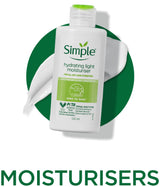
The Simple Kind to Skin Hydrating Light Moisturiser is built around exactly this idea. Glycerin and pro-Vitamin B5 do the actual work of drawing in and holding onto moisture, niacinamide helps support the skin's barrier so that moisture doesn't just evaporate again by midday, and allantoin sits quietly in the background, calming any redness or reactivity, without adding fragrance to a formula meant for sensitive skin in the first place.
Together, they let the moisturiser replenish properly without ever feeling heavy or occlusive, leaving dry, sensitive skin feeling comfortable and hydrated rather than weighed down.

| Tip: Apply moisturiser onto slightly damp skin, straight after cleansing, so the formula has some surface moisture to lock in rather than working from completely dry skin. |
Yes. A moisturiser can only add back what your cleanser hasn't already stripped away, so the wash you use before it matters just as much as the moisturiser itself. A harsh cleanse undoes a good chunk of what a hydrating moisturiser is trying to do, before it's even had a chance to absorb.
This is why a hydrating face wash is worth choosing deliberately rather than picking whatever's cheapest on the shelf. Look for the same soap-free, low-foaming qualities that make a moisturiser gentle, just in cleanser form.
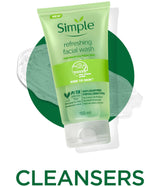
The Simple Kind to Skin Refreshing Facial Wash leans on pro-amino acids to gently lift away dirt and impurities without disturbing skin's natural barrier, while pro-Vitamin B5 helps replace a little moisture as it cleanses, rather than just taking moisture away the way a standard wash would. That combination means your moisturiser is working with clean, calm skin, rather than compensating for what the wash just undid.

A full routine really comes down to two consistent steps:
Consistency matters more than any single "hero" product, especially for skin that reacts easily to change. If you're specifically after a gentle moisturiser for sensitive skin, the safest test isn't how it feels in the first five minutes; it's how skin looks and feels the next morning. Genuine hydration shows up over hours, not instantly.
Dry, sensitive skin doesn't need a longer routine; it needs a genuinely evidenced one: a gentle cleanser and a moisturiser that can actually prove where its hydration is coming from, rather than a jar that simply says the right words.
If you're still checking labels before you buy, look at your cleanser and moisturiser as a pair rather than separate purchases, since one quietly affects how well the other performs. Explore Simple's Dry Skin range to see how a matched routine might work for your skin.
Not usually from hydration itself, but from what's paired with it. A very rich texture can feel heavy on some sensitive skin, so a lighter, humectant-based formula, like the Simple Kind to Skin Hydrating Light Moisturiser, is often more comfortable than a dense cream.
Fragrance-free is generally the safer choice for sensitive skin, since added fragrance is one of the more common triggers for irritation. It's worth checking for this on both cleansers and moisturisers, not just one or the other.
Give it two to three weeks of consistent use. A single application can feel comfortable without necessarily meaning the formula is genuinely hydrating skin over time.
It supports overall hydration, though it won't replace a topical moisturiser. Skin needs humectant ingredients applied directly to hold onto moisture at the surface, which drinking water alone doesn't address.
Yes, this is common, particularly around the T-zone, and doesn't cancel out dryness elsewhere. A lightweight, non-oily moisturiser generally suits this kind of in-between skin better than a heavier one.





We know that you care about your personal data and how it is used, and we want you to trust that Unilever uses your personal data carefully. This Privacy Notice will help you understand what personal data we collect, why we collect it and what we do with it.
As you read our Notice, please keep in mind that it applies to all Hindustan Unilever Limited.
Please take a moment to familiarise yourself with our privacy practices and let us know if you have any questions by sending us an email to Customer Care or submitting a request through the “Contact Us” form on our websites.
We have tried to keep this Notice as simple as possible, but if you’re not familiar with terms, such as cookies, IP addresses, and browsers, then please read about these key terms first.
You have the right to object to certain uses of your personal data including the use of your personal data for direct marketing. See what your rights are and how you can exercise them here.
Any personal data provided to or collected by Unilever is controlled by Hindustan Unilever Limited, the data controller.
This Privacy Notice applies to personal data collected by Unilever in connection with the services and products we offer. References to “Unilever” in this Notice means Hindustan Unilever Limited and any company directly or indirectly owned and/or controlled by Hindustan Unilever Limited that you are interacting with or have a business relationship with.
This Privacy Notice also applies to Unilever’s marketing content, including offers and advertisements for Unilever products and services, which we (or a service provider acting on our behalf) send to you on third-party websites, platforms and applications based on your site usage information. These third-party websites generally have their own Privacy Notice and Terms and Conditions. We encourage you to read them before using those websites.
Personal data means any information that can be used to identify directly or indirectly a specific individual.
You are not required to provide Unilever the personal data that we request, but if you choose not to do so, we may not be able to provide you with our products or services, or with a high quality of service or respond to any queries you may have.
We may collect personal data from a variety of sources. This includes:
Personal data means any information that can be used to identify directly or indirectly a specific individual. This definition includes personal data collected offline through our Consumer Engagement Centres, direct marketing campaigns, sweepstakes and competitions and online through our websites, applications and branded pages on third-party platforms and applications accessed or used through third-party platforms.
You may be asked to provide your personal data when you are in contact with us. Hindustan Unilever Limited companies may share your personal data with each other and other Unilever Group companies and use it in a manner consistent with this Privacy Notice. We may also combine it with other information to improve our products, services, content, and advertising.
You are not required to provide Unilever the personal data that we request, but if you choose not to do so, we may not be able to provide you with our products or services, or with a high quality of service or respond to any queries you may have.
We may collect personal data from a variety of sources. This includes:
Certain categories of personal data, such as health data, financial data, biometrics, race, ethnicity, religion, health, sexuality or biometric data are classified as “special categories of data” or “Sensitive Personal Information” and benefit from additional protection.
We limit the circumstances where we collect and process these special categories of data.
Unilever sometimes collects data related to your health such as allergies, pregnancy or skin type to send you tailored ads and relevant promotions. Unilever only collects and uses this personal data where you have provided us with your consent for us to do so. In some instances, you may have requested services or products that do not directly involve the collection of any special categories of data, but may imply or suggest your religion, health or other special categories of data.
To illustrate circumstances where Unilever collects and processes special categories of data we have provided the following examples:
We understand the importance of taking extra precautions to protect the privacy and safety of children using Unilever products and services.
Most of Unilever’s websites are designed and intended for use by adults. Where one of our websites is intended for use by a younger audience, we will obtain consent from the person with parental responsibility before we collect personal data where it is required by applicable laws and regulations (the age at which consent is necessary varies from Country to Country).
If you are a child under the age where parental consent is required in your Country, you should review the terms of this Privacy Notice with your parent or guardian to make sure you understand and accept them. If we discover that we have collected personal data from a child without consent from a parent or guardian where such consent should have been obtained, we will delete that personal data as soon as practical. Access to certain parts of the Unilever’s websites and/or eligibility to receive prizes, samples or other rewards are generally limited to users over a certain age.
We sometimes use your personal data to carry out age verification checks and enforce any such age restrictions.
We collect, process and disclose your personal data only for specific and limited purposes. For example, to process your payments, to assess and handle any complaints, to develop and improve our products, services, communication methods and the functionality of our websites, to provide personalised products, communications and targeted advertising as well as product recommendations to you.
We also create profiles by analysing the information about your online surfing, searching and buying behaviour and your interactions with our brand communications by building segments (creating groups that have certain common characteristics) and by placing your personal data in one or more segments.
Additionally, Unilever processes your personal data also using automated means. An automated decision is a decision which is made solely by automatic means, where no humans are involved in the decision-making process related to your personal data.
We collect, process and disclose your personal data for the following purposes:
When we collect and use your personal data for purposes mentioned above or for other purposes, we will inform you before or at the time of collection.
Where appropriate, we will ask for your consent to process the personal data. Where you have given consent for processing activities, you have the right to withdraw your consent at any time.
In some cases, we rely on legitimate interest for processing your personal data. A legitimate interest could exist for example, when you sign up for a loyalty scheme with one of our brands and we use the personal data collected to conduct data analytics to improve our products or services. This ground will only be used where it is necessary to achieve a legitimate interest, for example to assist in the performance of a contract, or to optimise a service, and does not outweigh your rights as an individual. This legal basis will only be relied upon where there is no less intrusive way to process your personal data. We can assure you that if legitimate interest is used as a ground for processing your personal data, we will keep a record of this and you have the right to ask for this information.
We process your personal data to perform a contract to which you are or will be a party. For example, we need to process your personal data to deliver a product or a service you bought, to allow you to take part in one of our competitions, or to send you samples that you have requested.
We also process your personal data when we have a legal obligation (e.g., tax or social security obligations) to perform such processing. For example, a court order or a subpoena may require us to process personal data for a particular purpose, or we may be compelled to process personal data to report suspicious transactions under the local anti-money laundering rules.
Unilever uses your personal data to build profiles. We create profiles by analysing the information about your online surfing, searching and buying behaviour and your interactions with our brand communications by building segments (creating groups that have certain common characteristics) and by placing your personal data in one or more segments. These segments are used by Unilever to personalise the website and our communications to you (such as showing relevant content to you when you visit our site or in a newsletter to you), and to display relevant offers and advertisements from the Unilever brands on the Unilever sites, and via third-party websites. The segments can also be used for third-party campaigns on the Unilever sites. Unilever profiles your data where you have provided consent for us to do so; for example, accepting the setting of cookies on your browser online or signing up for email newsletters from one of our brands.
You can withdraw your consent to prevent your personal data being used this way at any time using the manage cookies section of our Cookie Notice or unsubscribing to the use of your email address if you have logged into one of our websites or signed up to any marketing newsletters.
By way of example –
In some instances, Unilever processes your personal data using automated means. An automated decision is a decision which is made solely by automatic means, where no humans are involved in the decision-making process related to your personal data. For example:
We will not make decisions based solely on automated decision making that have significant impact on you. If we do so we notify you and provide you with clear information about our decision to rely on automated processing to make our decision and our lawful basis for doing so. For example, Unilever processes your personal data using automated means only if it is necessary for the entering into or the performance of a contract with you, or when you have given your explicit consent.
You have the right not to be subject to a decision which is based solely on automated processing and which produces legal or other significant effects on you. In particular, you have the right:
As part of the Unilever Group, a global business, Hindustan Unilever Limited shares your personal data within the Unilever Group and with selected third-parties in the following circumstances:
Unilever shares personal data within the Unilever Group or with third-parties for purposes described in this Privacy Notice.
Unilever will only send personal data collected within a restricted legal framework, such as e.g. the European Economic Area (EEA) or Asian Pacific Economic Cooperation (APEC), to countries which do not have data protection laws that are considered to provide appropriate levels of protection in the restricted legal framework in circumstances such as:
· To follow your instructions;
· To comply with a legal duty; or
· To work with our agents and advisers who we use to help run our business and services.
If we do transfer personal data to outside of the restricted legal framework, Unilever will make sure that it is protected in the same way as if it was being used in that restricted legal framework. We’ll use one of the following safeguards:
· Transfer to another Country whose privacy legislation ensures an adequate level of protection of personal data similar or equivalent to the country it was collected in;
Unilever takes the security of your personal data very seriously. We take every effort to protect your personal data from misuse, interference, loss, unauthorised access, modification or disclosure.
Our measures include implementing appropriate access controls, investing in the latest Information Security Capabilities to protect the IT environments we leverage, and ensuring we encrypt, pseudonymise and anonymise personal data wherever possible.
Access to your personal data is only permitted among our employees and agents on a need-to-know basis and subject to strict contractual confidentiality obligations when processed by third-parties.
We will keep your personal data for as long as we need it for the purpose it is being processed for. For example, where you make a purchase online with us we will keep the data related to your purchase, so we can perform the specific contract you have entered and after that, we will keep the personal data for a period which enables us to handle or respond to any complaints, queries or concerns relating to the purchase.
Your data may also be retained so that we can continue to improve your experience with us and to ensure that you receive any loyalty rewards which are due to you.
We retain the identifiable data we collect directly for targeting purposes for as little time as possible, after which we employ measures to permanently delete it.
We will actively review the personal data we hold and delete it securely, or in some cases anonymise it, when there is no longer a legal, business or consumer need for it to be retained.
Your rights in relation to your personal data how it is processed. You can exercise these rights at any point. We have provided an overview of these rights below together with what this entails for you. You can exercise your rights by sending an email or submitting a request through the “Contact Us” form on our websites.
Where we process your personal data, you have a number of rights over how the data is processed and can exercise these rights at any point. We have provided an overview of these rights below together with what this entails for you. You can exercise your rights by sending an email or submitting a request through the “Contact Us” form on our websites.
Further information and advice about your rights can be obtained from the data protection Regulator in your Country.
We are committed to protect your personal information collected and processed by us and look forward to your continued support for the same. If you have any query, grievance with respect to the processing of information by us, you can reach out to us by calling our Toll Free No. 1800-10-22-221 or by email to lever.care@unilever.com or submitting a request through the “Contact Us (Privacy Request/Concern)” form available on the HUL website.
You can also reach out to our Privacy Office in the event of any escalation or absence of resolution of grievance, requests, rights pertaining to personal data processed by us. You may contact our DPO/Privacy Grievance Officer at (1) The Data Protection Officer/Privacy Grievance Officer, Hindustan Unilever Limited, Unilever House, B. D. Sawant Marg, Chakala, Andheri (E), Mumbai - 400 099 or at: Grievance.Officer-Privacy@unilever.com. You can also call on the aforementioned contact number and request it to be referred to the DPO/Data Protection Office.
When a privacy question or access request is received, we have a dedicated team which triages the contacts and seeks to address the specific concern or query which you are seeking to raise. Where your issue may be more substantive in nature, more information may be sought from you. If you are unsatisfied with the reply received, you may refer your complaint to the relevant Supervisory Authority. If you ask us, we will endeavour to provide you with information about relevant complaint avenues which may be applicable to your circumstances.
We will update this Privacy Notice when necessary to reflect customer feedback and changes in our products and services. When we post changes to this statement, we will revise the “last updated” date at the top of this Notice. If the changes are significant, we will provide a more prominent notice (including, for certain services, email notification of Privacy Notice changes). We will also keep prior versions of this Privacy Notice in an archive for your review.
We will not reduce your rights under this Privacy Notice without your consent.
In addition to this Privacy Notice, there may be specific campaigns or promotions which will be governed by additional privacy terms or notices. We encourage you to read these additional terms or notices before participating in any such campaigns or promotions as you will be required to comply with them if you participate. Any additional privacy terms or notices will be made prominently available to you.
Last Updated: 4th December, 2023
At Unilever, we respect your concerns about privacy and value the relationship that we have with you.
Like many companies, we use technology on our website, applications, platforms, etc. to collect information that helps us enhance your experience and our products and services. The cookies that we use at Unilever allow our website to work and help us to understand what information and advertising is most useful to visitors.
Please take a moment to familiarise yourself with our cookie practices and let us know if you have any questions by sending us an e-mail or submitting a request through the “Contact Us” form on our websites. You can also reach out to the DPO for any grievance as provided under “How to Contact Us” Section of our Privacy Notice.
We have tried to keep this Notice as simple as possible, but if you’re not familiar with terms, such as cookies, IP addresses, and browsers, then read about these key terms first.
Cookies, pixel tags and similar technologies (collectively ‘cookies’) are files containing small amounts of information which are downloaded to any internet enabled device – such as your computer, smartphone or tablet – when you visit a website. Cookies are then sent back to the originating website on each subsequent visit, or to another website that recognises that cookie. Cookies do lots of different and useful jobs, such as remembering your preferences, generally improving your online experience, and helping us to offer you the best product and services.
There are many types of cookies. They all work in the same way, but have minor differences. For a detailed list of cookies used on our websites, please refer to the below relevant section.
Any personal data provided to or collected by Unilever via cookies and other tracking technologies is controlled by Hindustan Unilever Limited, the data fiduciary.
This Cookie Notice applies to any websites, apps, branded pages on third-party platforms (such as Facebook or YouTube), and applications accessed or used through such websites or third-party platforms (hereinafter, “our websites”) which are operated by or on behalf of Unilever. References to “HUL/Unilever” in this Notice include any Hindustan Unilever Limited or Unilever Plc companies, subsidiaries, affiliates, joint ventures and franchises that you are interacting with or have a business relationship with.
By using our websites, applications, etc., you are consenting to our use of cookies in accordance with this Cookie Notice and our Privacy Notice. If you do not agree to our use of cookies in this way, you should set your browser settings accordingly, disable the cookies that we use or not use our websites at all. If you disable the cookies we use, this may impact your user experience while on the websites.
The section below summarises the different types of cookies we use on our websites, together with their respective purpose and provides you with the ability to manage these cookies.
Unilever will only collect, use or disclose your personal data where it is fair and lawful to do so.
For a more detailed understanding of how we use personal data collected by Unilever cookies, please refer to our Privacy Notice.
We use cookies to make Unilever websites easier to use, to deliver a personalised experience on our websites, and to better tailor our products, services and websites to your interests and needs. Cookies are used to help speed up your future activities and your experience on Unilever websites.
The cookies you consent to, are also used to collect your personal data which we then profile into audiences so that we can deliver targeted advertising tailored to your interests and limit the number of times you see an advertisement. For more detailed information about the profiling activities Unilever undertakes with your personal data for advertising, please see our Privacy Notice.
We also insert cookies in emails and newsletters to improve our content and advertising.
Lastly, we use cookies to compile anonymous, aggregated statistics that allow us to understand how people use our websites and to help us improve their structure and content and also help us measure the effectiveness of advertising campaigns on Unilever and non-Unilever websites.
More detailed information about the types of cookies we use and for what purposes, can be found in the below relevant section.
There are many ways to manage your cookies:
Control via your browser settings
Most internet browsers are initially set up to automatically accept cookies. If you do not want our websites to store cookies on your device, you can change your browser settings so that you receive a warning before certain cookies are stored. You can also adjust your settings so that your browser refuses most of our cookies or only certain cookies from third parties. You can also withdraw your consent to cookies by deleting the cookies that have already been stored.
If you disable the cookies that we use, this may impact your experience while on the Unilever website, for example you may not be able to visit certain areas of a website or you may not receive personalized information when you visit a website.
If you use different devices to view and access the Unilever website (e.g., your computer, smartphone, tablet) you will need to ensure that each browser on each device is adjusted to suit your cookie preferences.
The procedures for changing your settings and cookies differ from browser to browser. If necessary, use the help function on your browser or click on one of the links below to go directly to the user manual for your browser.
There are also software products available that can manage cookies for you.
You can also use www.ghostery.com to evaluate the use of cookies used on our websites.
To find out more about cookies, including how to see what cookies have been set and how to manage and delete them, visit www.allaboutcookies.org.
The cookies used on Unilever websites may be generally categorised as follow:
The cookies used on Unilever websites may be generally categorised as follow:
In terms of duration, we may use two different types of cookies on our websites:
We will update this Privacy Notice when necessary to reflect customer feedback, our practices, scope of processing, and changes in our products and services. When we post changes to this statement, we will revise the “last updated” date at the bottom of this Notice. We encourage you to periodically review this page for the latest information on the Notice. Your continued use of the Site, application, etc., constitutes your agreement to be bound by such changes to this Notice. Your only remedy, if you do not accept the terms of this Notice, is to discontinue use of and access, subject to applicable law. You acknowledge that this Notice may contain inadvertent inaccuracies or errors and is subject to change, and we expressly exclude liability for any such inaccuracies or errors to the fullest extent permitted by law.
Last Updated: 4th December, 2023
No Matched Products For Applicable
Coupons
SCRUB25
Get 25% off on all scrubs
Have a coupon ? Apply next step
Coupons & Offers
Apply now and save extra!